
At our recent Lauder Teacher Expert Briefing, Ben O’Connor, Investment Director at Apache Capital Partners, explored what may prove to be one of the most significant investment opportunities emerging across the UK living sectors market.
Apache Capital has been at the forefront of institutional residential investment for more than a decade, helping pioneer both multifamily and single-family rental housing across the UK. As one of the country’s largest specialist residential investors, developers and operators, the firm’s perspective carries particular weight as the market enters a new phase of development.
The discussion centred on a simple but increasingly important observation: while institutional investors have spent much of the past decade focused on premium build-to-rent schemes in major cities, the greatest long-term opportunity may lie elsewhere.
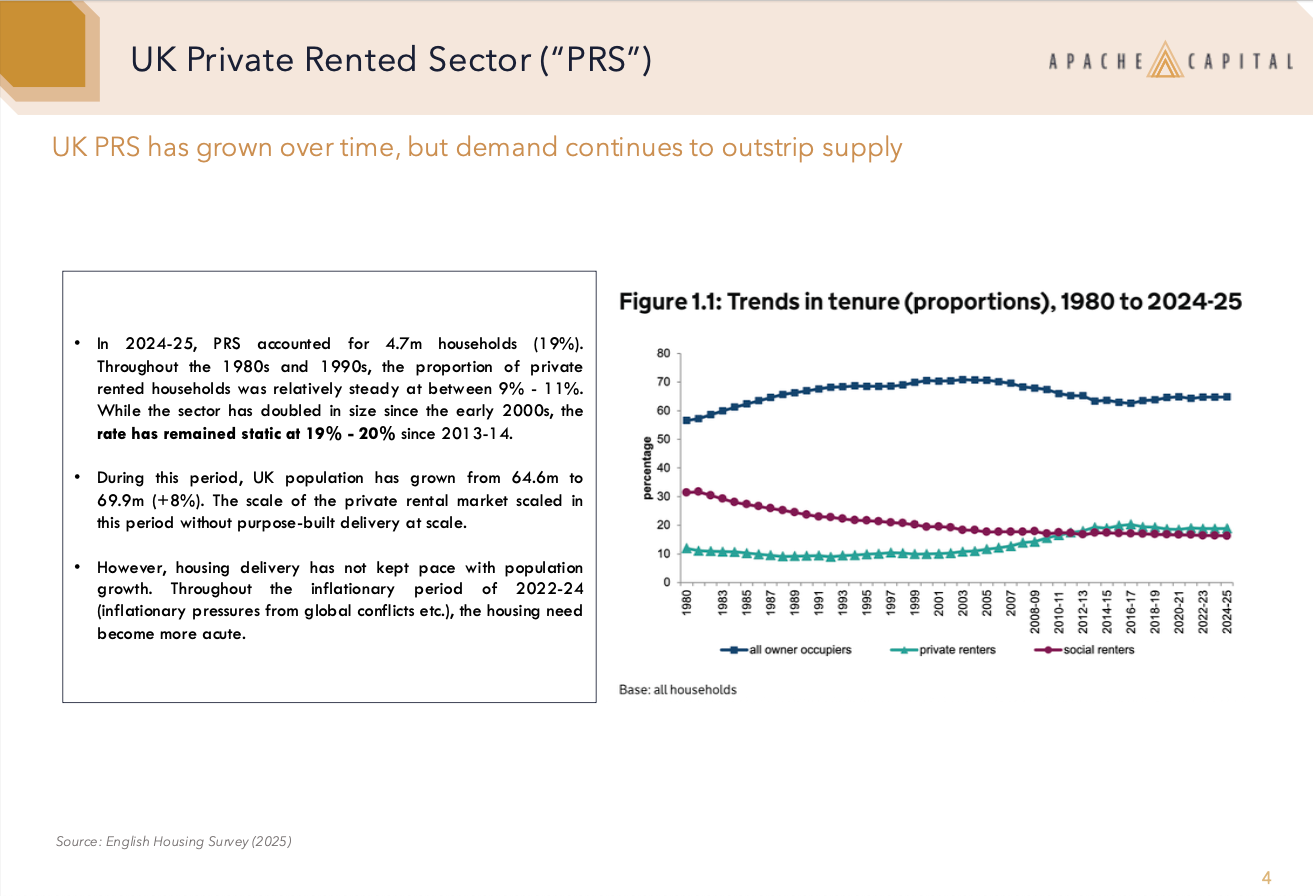
Beneath the headlines surrounding housing delivery, affordability and planning reform sits a vast and chronically underserved segment of the market. It is occupied by middle-income households who earn too much to qualify for affordable housing, yet increasingly struggle to access home ownership. They are neither luxury renters nor social housing tenants. They sit within what many investors are beginning to describe as the UK’s rental “missing middle”.
For years this market has been served almost entirely by individual private landlords. Today, however, the foundations of that model are beginning to shift.
As private landlords continue to exit the sector, housing delivery remains constrained, and demographic trends reshape how and where people choose to live, institutional capital is increasingly being drawn towards a segment that represents not a niche opportunity, but arguably the largest and most important part of the UK’s rental market.
The UK rental market is changing
The UK’s private rented sector has expanded dramatically over the past two decades.
Approximately one in five households now rents privately, making it one of the most important tenures in the country’s housing system. Yet despite its scale, the sector remains characterised by persistent undersupply.
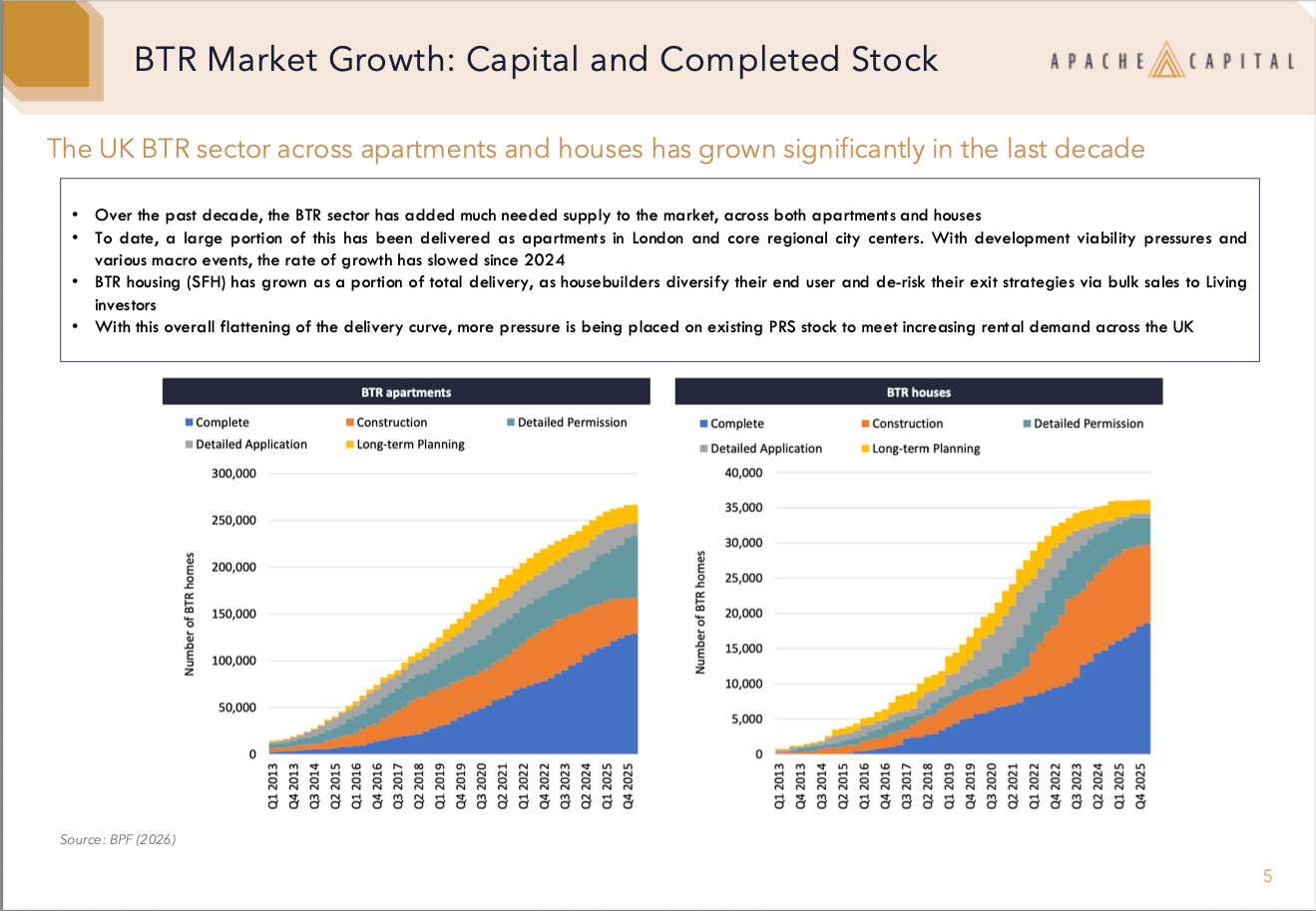
Population growth has continued. Household formation has continued. Demand for rental accommodation has continued to rise. Housing delivery, however, has failed to keep pace.
The consequence is a structural imbalance that has become increasingly visible across the country. Rental growth has accelerated, affordability pressures have intensified, and competition for available homes has become a defining feature of many local markets.
This challenge is being compounded by a second, equally important trend. The traditional private landlord model that underpinned the growth of the sector is retreating.
For decades, individual buy-to-let investors provided the overwhelming majority of rental housing stock. Today, higher borrowing costs, taxation changes, increased regulation, compliance requirements, and energy efficiency obligations are encouraging many landlords to reduce exposure or leave the sector altogether.
This matters because institutional ownership still accounts for only a small proportion of UK rental housing.
As individual landlords sell homes into the owner-occupier market faster than new professionally managed stock is being delivered, the rental supply deficit is becoming more acute.
What emerges is not simply a housing shortage. It is a supply vacuum. And supply vacuums rarely persist for long.
Why the first generation of build-to-rent only solved part of the problem
Institutional capital has already begun addressing some of these challenges.
Over the past decade, the UK build-to-rent sector has evolved from a niche investment strategy into a recognised institutional asset class. Billions of pounds of capital have been deployed and hundreds of thousands of homes have been delivered, planned or funded.
The sector has professionalised renting, improved management standards, and demonstrated that large-scale residential investment can generate attractive long-term returns. However, the first phase of institutional rental housing was largely focused on one specific demographic.
Most development occurred in city centres. Schemes typically targeted higher-income renters. Amenities became increasingly important differentiators, with gyms, cinemas, roof terraces, concierge services, resident lounges, and co-working facilities becoming standard features.
These developments have performed well and continue to meet genuine demand. The question, however, is whether they represent the largest opportunity.
The reality is that most renters do not live in landmark apartment towers. Most renters do not spend their evenings in private cinema rooms. Most renters are not seeking luxury lifestyles. Most renters simply want a good-quality home, managed professionally, in a location that allows them to work, raise families, participate in their local communities, and live within reasonable affordability parameters. That market is significantly larger than the premium segment.
The rise of the rental middle class
Perhaps the most important trend underpinning the investment case is demographic change. The traditional assumption that renting is a temporary stage of life is becoming increasingly outdated. Across the UK, renters are ageing.
More households are spending longer periods in the private rented sector. Many are reaching life stages historically associated with home ownership while remaining renters. Families with children, dual-income professional households, key workers, and middle-income earners now represent a growing proportion of demand. In many cases this is not entirely by choice.
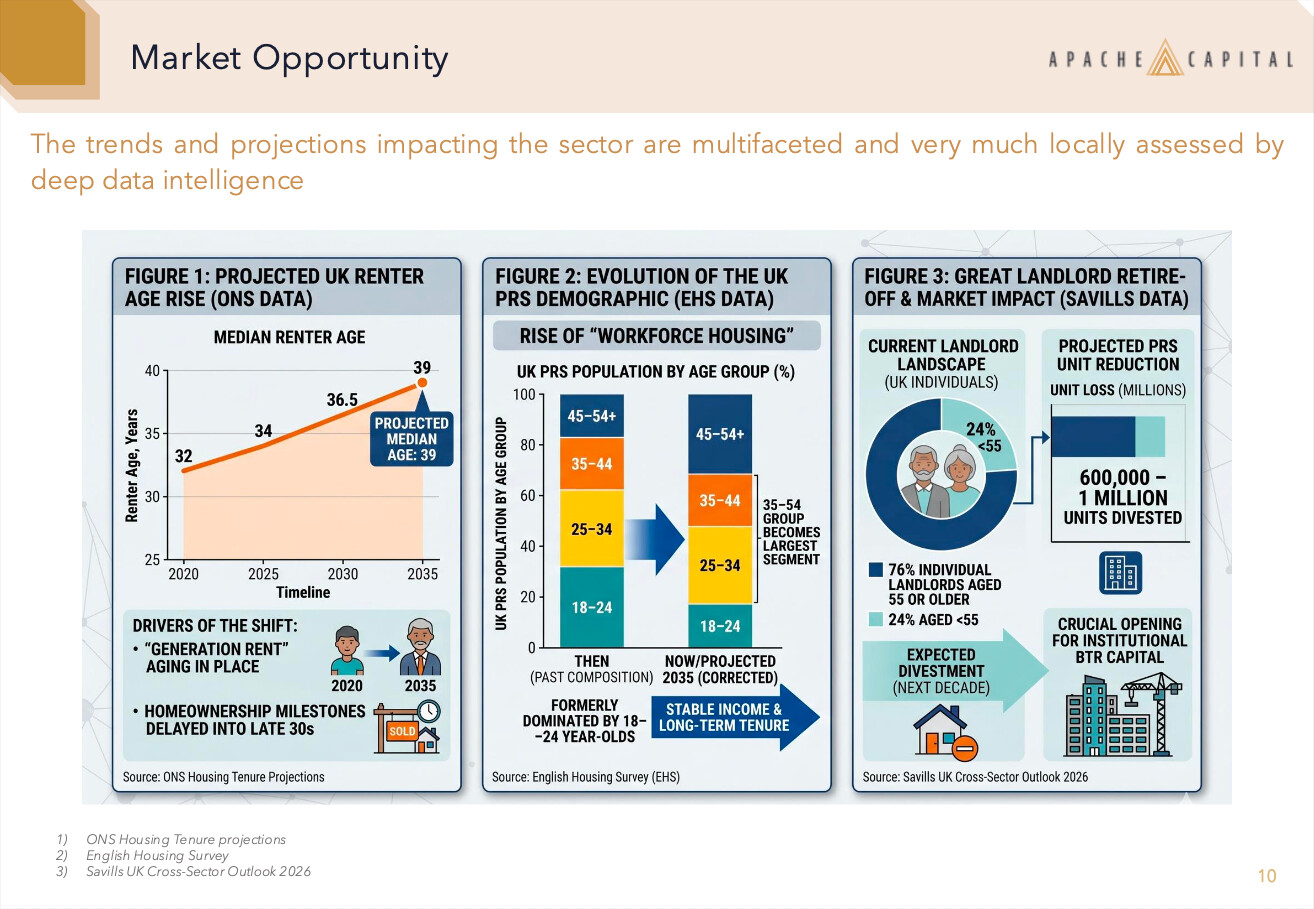
House price inflation has consistently outpaced wage growth in many regions. Deposit requirements remain significant barriers to entry. Mortgage affordability tests continue to constrain first-time buyers.
Yet there is another important shift taking place. The quality gap between renting and ownership is narrowing.
Historically, renting often meant compromising on quality, stability, or security of tenure. Professionally managed housing is beginning to change that equation.
For a growing cohort of households, renting is becoming a long-term housing solution rather than a temporary necessity. This evolution fundamentally alters the type of housing that investors should be providing.
Defining the UK’s missing middle
The term “mid-market” can sometimes feel vague, but the underlying concept is straightforward. It refers to professionally managed housing that is affordable to large groups of middle-income households. Importantly, this is not a fixed national price point. The mid-market in Manchester is different from the mid-market in Bristol. Birmingham differs from Reading. Outer London differs from central London. What matters is not absolute rent levels but affordability relative to local incomes. This distinction shifts the focus away from buildings and towards consumers.
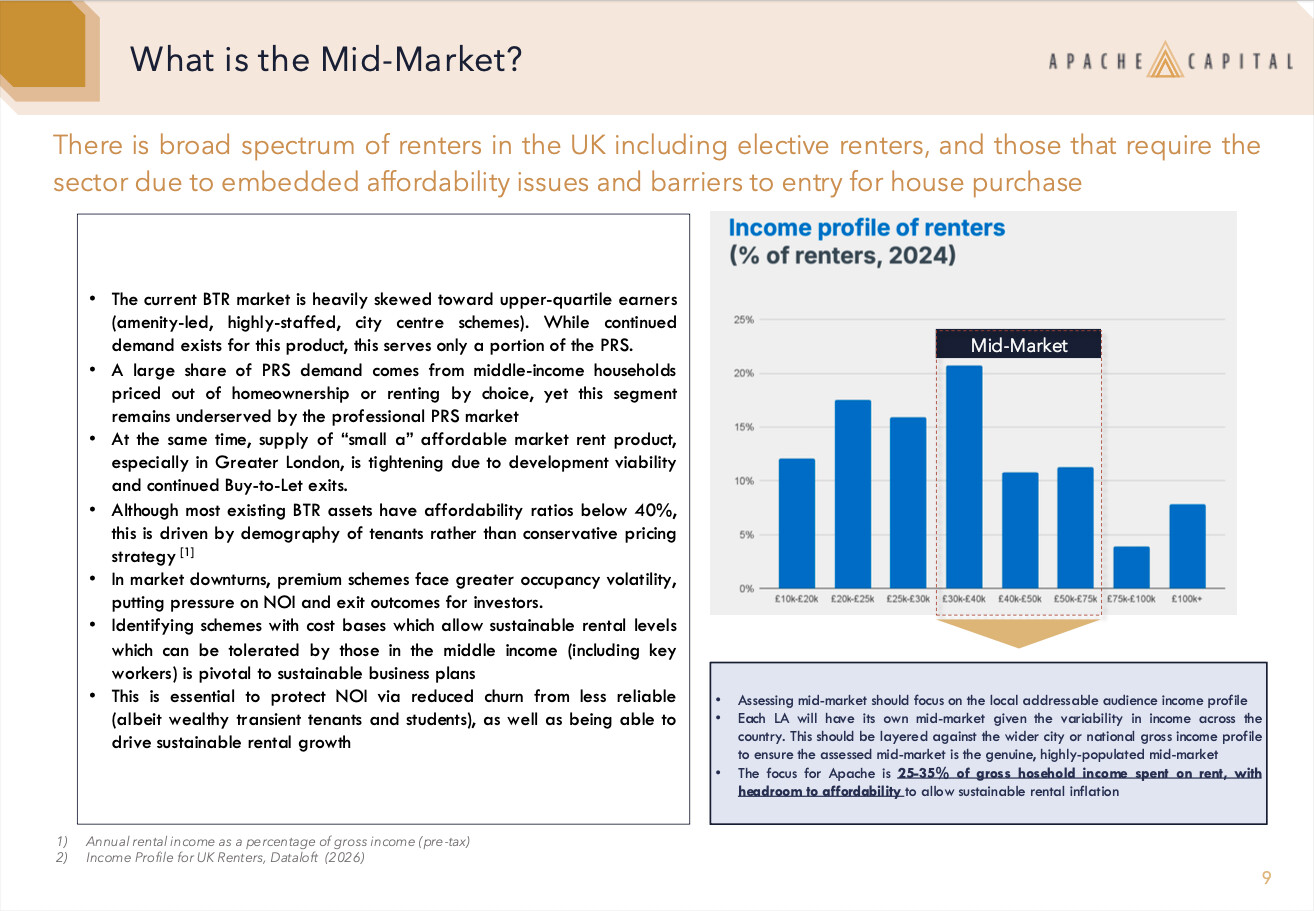
The most successful investors increasingly begin by understanding who lives in a market, what they earn, how they work, what stage of life they occupy, and what housing compromises they are currently making. Viewed through this lens, the opportunity becomes difficult to ignore.
There is a substantial gap between social housing and premium institutional rental product. Millions of households sit within that gap. The market exists. The demand exists. The question is whether sufficient supply can be delivered.
Why institutional capital is moving down the affordability curve
Several structural factors are accelerating investor interest in mid-market rental housing.
First, there is simply more demand.
Middle-income households represent a significantly larger addressable market than premium renters. They also tend to exhibit different behavioural characteristics, often seeking longer tenancies, greater stability, and stronger community connections.
Second, the economics increasingly make sense.
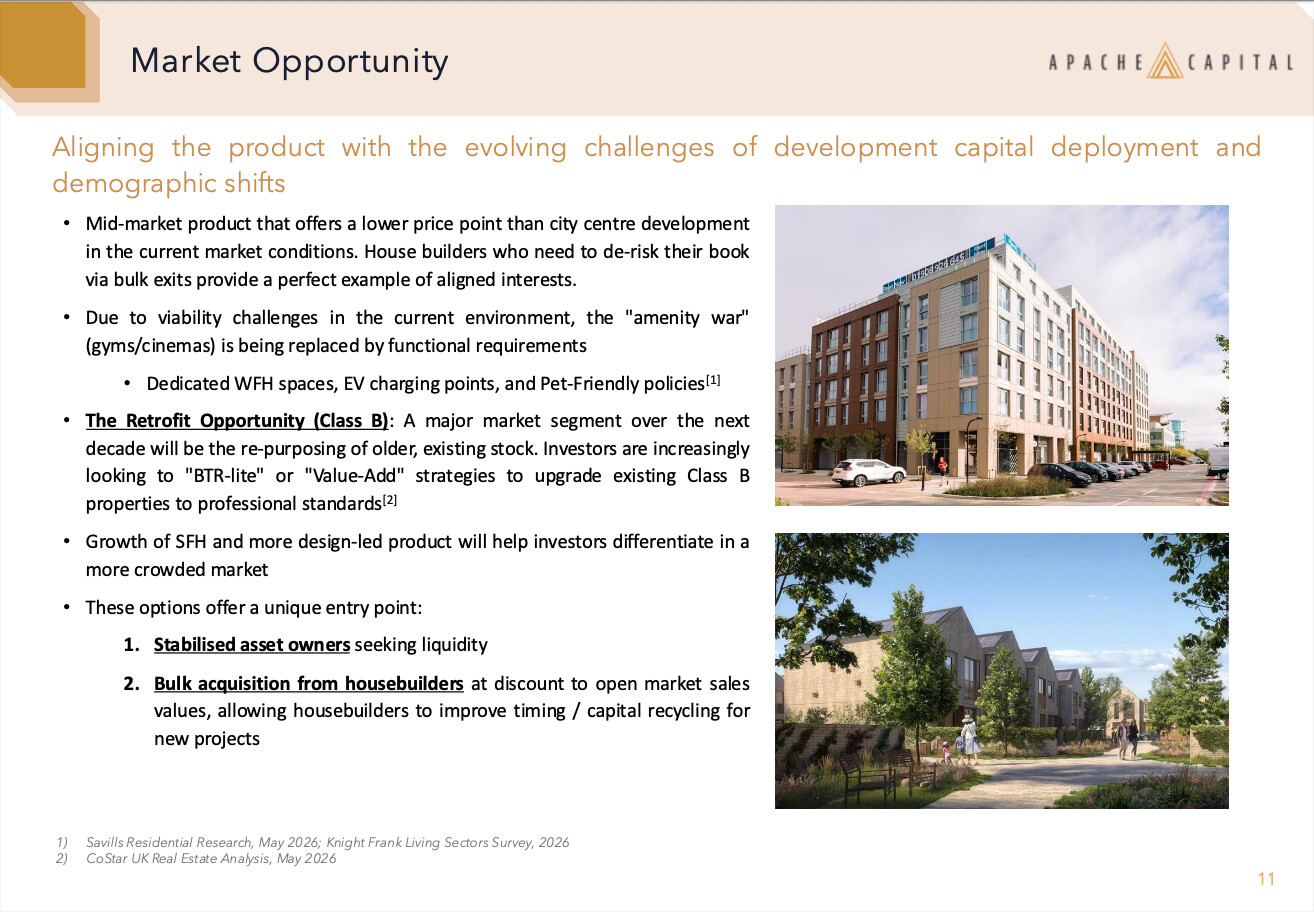
As development viability becomes more challenging, the sector is moving beyond what some have described as the “amenity arms race”. Expensive lifestyle features are becoming harder to justify when affordability has become the defining issue for many renters.
Functional amenities are replacing aspirational ones. Dedicated work-from-home space. Pet-friendly policies. Electric vehicle charging. Energy-efficient homes. Access to green space. Thoughtful design and interiors. These features often matter more to residents than rooftop bars or cinema rooms.
Third, housing delivery itself is changing.
Many housebuilders are increasingly seeking institutional partners to provide certainty of execution and capital recycling opportunities. Bulk sales to residential investors can help de-risk development pipelines while creating opportunities for long-term owners to acquire stock at scale.
Finally, operational expertise is becoming a genuine source of competitive advantage.
Institutional investors are no longer simply acquiring buildings. They are operating housing businesses. The ability to understand customers, manage communities, minimise churn, and deliver consistent resident experiences may become increasingly valuable as the sector matures.
The next phase of institutional residential investment
The UK housing market faces no shortage of challenges. Housing delivery remains insufficient. Affordability pressures remain deeply embedded. Demographic trends continue to support rental demand. Private landlord participation appears likely to decline further before stabilising. Against this backdrop, the case for professionally managed rental housing continues to strengthen.
The key question is where institutional capital chooses to focus.
For much of the past decade, the sector’s growth has been defined by prime city-centre developments and premium rental experiences. The next chapter may look very different.
It may be defined by investors recognising that the greatest opportunity is not necessarily at the top of the market, but in the broad middle ground where millions of households already live.
If the first generation of build-to-rent was about proving that institutional rental housing could work, the next generation may be about proving that it can work at scale for the mainstream rental market. That is ultimately what makes the UK’s missing middle such an important investment theme.
This is not a niche strategy. It is not a specialist corner of the market. It is the core of where Britain’s renters increasingly live, work, and build their lives. For investors willing to embrace that reality, the opportunity may be measured not in years, but in decades.
A recording of the session is available to view on our website: See below or a direct link to Watch here.